 |
| |
| Economy |
|
| |
|
|
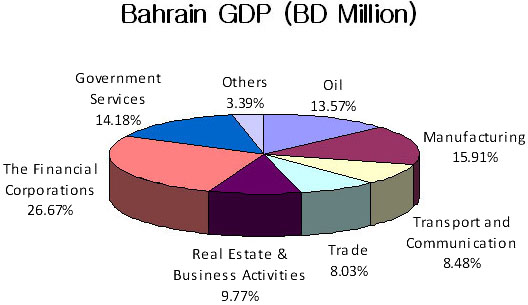
The discovery of oil in the 1930s transformed
Bahrain into the Gulf's first oil economy, but early acknowledgement
on the part of the Government that oil resources could not
generate sustainable economic growth led to the well-engineered
diversification program that has yielded today's broad economic
base, where oil refining and manufacturing coexist with
sophisticated financial, commercial and service sectors.
Bahrain is the most diversified and least oil dependent
country in the GCC states.
|
|
Source: Ministry of Finance and National
Economy, National Accounts 2007
 |
Bahrain became a member
of the United Nations and the Arab League in 1971. In May
1981 it joined its five neighbours - Kuwait, Oman, Qatar,
Saudi Arabia, and the United Arab Emirates and formed the
strategic alliance called the Gulf Co-operation Council
(GCC). The GCC seeks to strengthen cooperation in areas
such as agriculture, industry, security, investment and
trade among its six member states.
Bahrain has an independent legal and judicial
system with a framework of commercial laws and, on this
strength and its well-developed infrastructure, has become
an international and GCC arbitration centre.
Bahrain has been ranked the 16th freest economy in the world, ahead of Japan, Germany, France, India and China and the freest economy in the Middle East according to 2009 Heritage Foundation/Wall Street Journal Index of Economic Freedom. It is ranked as the most liberal economy in the Arab world and boasts one of the most modern cosmopolitan societies in the entire region. It is also the region's financial and banking centre with some 400 banks and financial institutions. The government of Bahrain encourages free trade and foreign investment by allowing 100% foreign ownership and control of company assets and enforces no personal, corporate or withholding taxes. |
According to World Investment Report, UNCTAD (September, 2008), the Inward Performance Index 2007, Bahrain rank the 12th position out of 141 economies, ahead of all GCC nations. For the Outward Performance Index 2007, Bahrain ranks 9th of 141 economies, and is ranking ahead of the GCC nations United Arab Emirates, Qatar and Saudi Arabia.
The country is also a founding member
of the WTO, having gained accession in January 1955.
Determined to maintain an open economy that is conducive
to both economic and social growth, Bahrain continues
to evolve its legal and administrative infrastructure.
The most significant move on the part of the Government,
in this regard, has been the introduction of the new
Commercial Companies Law that has come into effect
on January 1, 2002. |
|
|
| Main Economic Indicators |
2006 |
2007 |
2008 |
| External Total Investment (USD Millions) |
- |
- |
217,584 |
| Total Foreign Direct Investment (USD Millions) |
- |
- |
202,201 |
| Aluminium (Metric Tonnes) |
860,435 |
865,048 |
871,658 |
| Crude Oil (US Barrels Thousands) |
66,908 |
67,262 |
66,864 |
| Consumer Price Index (2006=100) |
100.0 |
103.3 |
106.9 |
| Average Monthly Wages in Private Sector (USD) |
557 |
616 |
704 |
| Average Monthly Wages in Public Sector (USD) |
1,857 |
2,053 |
2,125 |
Source: Central Bank of Bahrain
Investment Incentives
- 100% foreign ownership of companies;
- 100% foreign ownership of land;
- No restrictions on repatriation of capital, profits or dividends;
- Highly favourable tax environment with no personal, corporate
or withholding taxes;
- Easy access to visas;
- A cost effective, highly trained, bilingual workforce;
- "Fast track" registration;
- No custom duties on imports;
- GCC Customs Union in place;
- Strategic geographic location as a transit centre in regional market;
- Free movement of capital and foreign exchange;
- Sophisticated internationally oriented & highly developed legal framework;
- Mature legal and administrative infrastructure;
- Well developed offshore facilities;
- Advanced telecommunication;
- Proximity and strong business ties with the major markets;
- "One-stop" facility responsible for assisting investors with application procedures.
Money & Currency
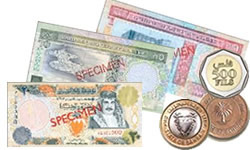
The national currency
is Dinar, with each dinar divided into 1,000 fils. The Bahraini
Dinar is pegged with the US dollar at US$ 1= BD0.377. Notes
are available in denominations of 1 dinar, 5 dinars, 10
dinars, and 20 dinars. Coins come in units of 5, 10, 25,
50, and 100 fils. Currency can be easily exchanged at the
airport, hotels, banks and the money changers. |
|
Business Hours
| Establishment |
Day |
Time |
Remarks |
| Government offices |
Sunday – Thursday |
07:00 – 14:15 |
Some government offices open for the public
from 07:30 – 12:30/3:00/4:30 |
| Banks |
Sunday – Thursday |
07:30 – 13:00 |
A few branches of some banks also open in the
afternoons |
| Commercial establishments |
Sunday – Thursday |
08:00 - 13:00 |
Some establishments work 5 days and some 5.5
days a week |
| Shops |
7 days a week |
08:00 – 12:30 & 16:00 – 20:00 |
Some shops are closed on Fridays Some department
stores and chemists are open 24-hours a day |
|
|
|